
Chatbots aren’t new, but they’ve changed. A lot.
If you’ve ever interacted with a website chatbot that kept repeating the same menu options or forced you into clicking preset buttons, you’ve experienced a traditional rule-based bot. It follows scripts. It works inside rigid decision trees. And while it can answer basic questions, it often struggles the moment a conversation moves off script.
Now compare that to an AI-powered chatbot that understands natural language, remembers previous interactions, adapts responses in real time, and even learns from conversations over time. That’s not just automation. That’s intelligent engagement.
And the difference matters more than most businesses realize.
What Is a Traditional Chatbot?
 Traditional chatbots operate on predefined rules. They follow scripts. They don’t improvise.
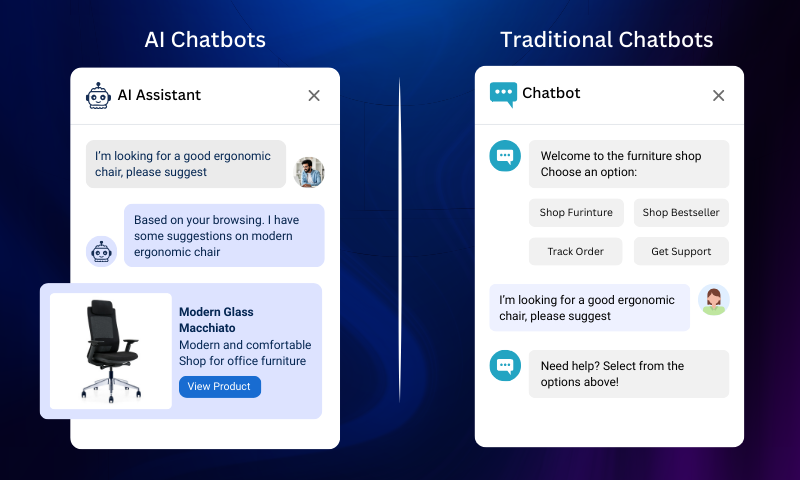
These bots are built using decision trees that guide users through a structured path of questions and answers. For example, a rule-based chatbot might ask, “How can I help you today?” and then present three buttons: Sales, Support, or Billing. The user clicks one, and the bot provides pre-written responses based on that selection.
It’s efficient. It’s predictable. It’s limited.
If a user types something unexpected or phrases a question differently than anticipated, the bot often fails to understand and redirects back to a generic response. That’s because traditional bots don’t truly “understand” language. They only match keywords to pre-programmed answers.
For businesses exploring basic chatbot development for businesses, rule-based bots can handle FAQs, appointment scheduling, and simple customer inquiries. They reduce some workload. They save some time.
But they don’t scale well when conversations become complex.
What Is an AI Chatbot?
 AI-powered chatbots are fundamentally different.
They use natural language processing (NLP), machine learning, and contextual understanding to interpret what users are actually saying, not just match keywords. Instead of following rigid scripts, AI chatbots analyze intent, learn from past interactions, and generate responses dynamically.
They’re flexible. They’re adaptive. They’re intelligent.
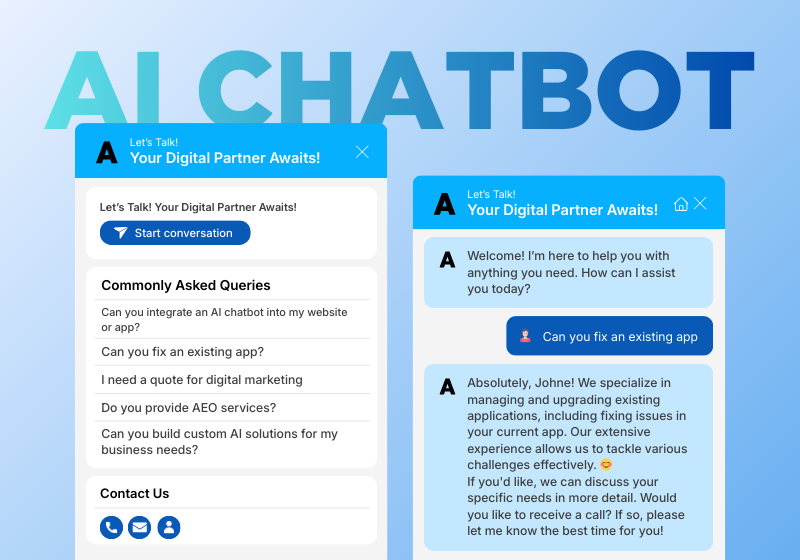
An AI chatbot can understand variations of the same question, recognize follow-up context, and personalize responses based on user behavior or previous interactions. If a customer asks, “Do you offer payment plans?” and then follows up with, “What about larger projects?” The AI bot understands the connection between those two questions.
That’s conversational continuity. That’s smart automation.
And that’s why businesses are increasingly investing in AI Chatbot Development Services rather than sticking with traditional rule-based systems.
The Core Differences
Let’s break it down clearly.
- Traditional chatbots operate on rules.
- AI chatbots operate on intelligence.
- Traditional bots respond to commands.
- AI bots respond to intent.
A rule-based chatbot is like a flowchart. Every possible interaction must be mapped out in advance. If something isn’t programmed, it doesn’t exist.
An AI chatbot, on the other hand, processes language patterns, context, and even sentiment to generate appropriate responses. It doesn’t just follow a map. It learns the terrain.
This difference directly impacts customer experience. And customer experience impacts revenue.
Why AI Chatbots Are a Game-Changer for Businesses
 Customer expectations are higher than ever. People want fast answers, personalized interactions, and seamless support without friction. If a chatbot frustrates them, they leave. Quickly.
AI chatbots improve satisfaction by delivering more human-like conversations that feel natural rather than mechanical. They can handle multi-step inquiries, recommend products based on user behavior, qualify leads, and even assist with sales conversations in real time.
That’s not just support. That’s growth.
For example, an AI marketing agency in Charlotte might deploy an AI chatbot that not only answers service questions but also asks qualifying questions, gathers lead information, schedules consultations, and integrates directly with CRM systems. The result is a streamlined sales pipeline operating 24/7.
No breaks. No missed opportunities. No manual bottlenecks.
Operational Efficiency and Scalability
 Traditional chatbots reduce workload in limited ways, but AI chatbots transform operations. They can handle high volumes of inquiries simultaneously, reducing pressure on human teams while still delivering personalized interactions.
That means fewer repetitive tasks for staff and faster response times. It means higher conversion rates.
AI chatbots can also integrate with internal systems, pulling real-time data such as order status, appointment availability, or customer account information. Instead of directing users to email or call for assistance, the bot resolves issues instantly.
- Efficiency improves.
- Costs decrease.
- Customer loyalty increases.
Personalization at Scale
 One of the most powerful advantages of AI chatbots is personalization. They can analyze browsing behavior, previous purchases, geographic data, and past conversations to tailor responses uniquely to each user.
That’s powerful. It builds trust and drives conversions.
Imagine a returning customer visiting your website. An AI chatbot can greet them by referencing their previous inquiry or suggest relevant services based on their interests. A traditional chatbot simply can’t do that without extensive manual programming- and even then, it lacks adaptability.
This is why advanced chatbot development for businesses now centers on AI capabilities rather than rigid decision trees.
When Traditional Chatbots Still Make Sense
To be fair, traditional chatbots aren’t obsolete. For small websites with very limited support needs and tight budgets, rule-based bots can still provide value.
- They’re simple.
- They’re affordable.
- They’re predictable.
But as businesses grow, customer journeys become more complex. And that’s when limitations start to show.
If your business relies on meaningful customer interaction, lead qualification, eCommerce transactions, or personalized marketing, AI chatbot solutions offer significantly greater long-term value.
The Competitive Edge
 Here’s the reality. AI is reshaping digital engagement. Consumers notice the difference. And competitors are adapting.
Businesses that adopt AI Chatbot Development Services early position themselves ahead of the curve. They create smoother customer experiences, capture more qualified leads, and reduce operational strain. Meanwhile, companies relying solely on outdated rule-based bots risk falling behind in both engagement and efficiency.
The choice isn’t just about technology. It’s about strategy.
The Bottom Line
- Traditional chatbots answer questions.
- AI chatbots build conversations.
- Traditional bots automate tasks.
- AI bots create opportunities.
If your goal is simply to reduce basic inquiries, a rule-based chatbot may suffice. But if your goal is to elevate customer experience, scale intelligently, and turn website visitors into loyal customers, AI-powered chatbots offer a transformative advantage.
For businesses ready to take that next step, partnering with an experienced AI marketing agency in Charlotte can ensure your chatbot solution is strategically built, seamlessly integrated, and optimized for performance.
Because in today’s digital landscape, automation alone isn’t enough. Intelligence wins.